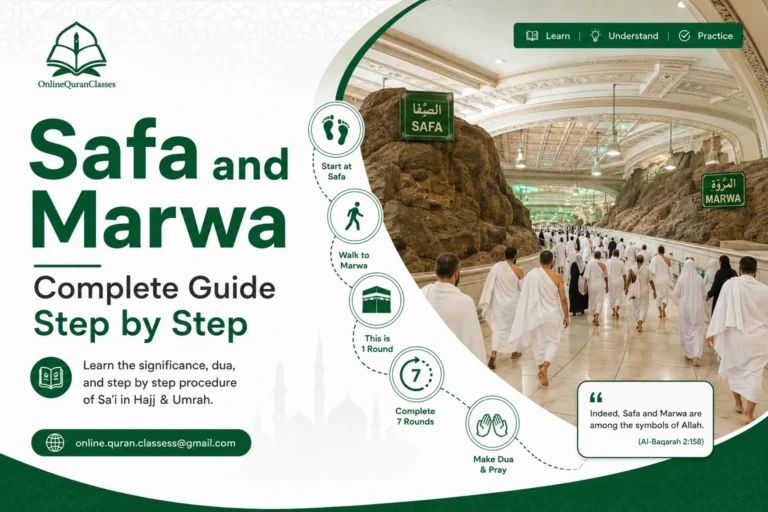
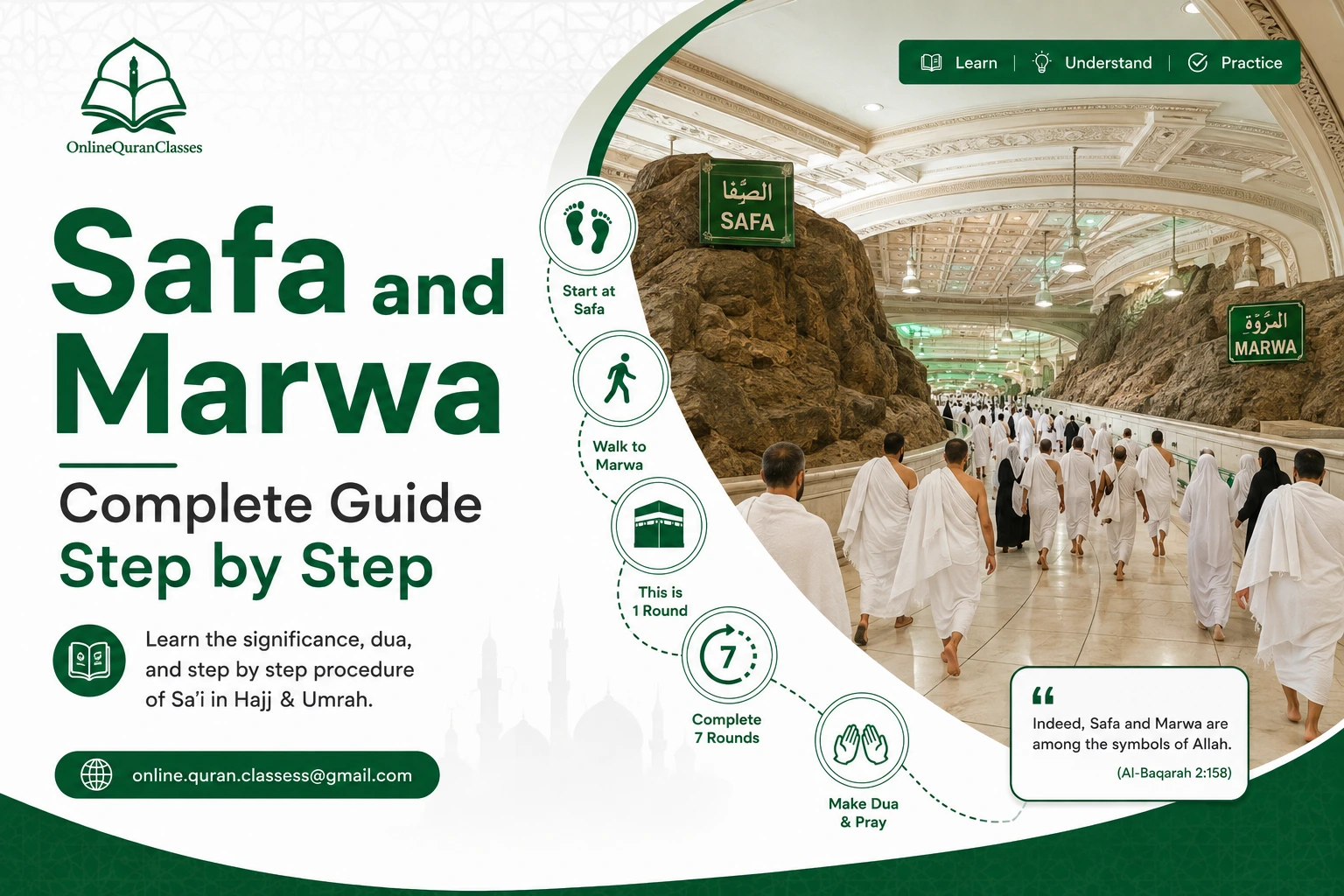
Safa and Marwa are two sacred hills located within Masjid al-Haram in Makkah. Walking between these two hills, known as Sa’i, is one of the essential rituals of Umrah and Hajj. It commemorates the struggle and faith of Hajar (AS), who searched for water for her infant son Ismail (AS).
For pilgrims performing Umrah for the first time, understanding the significance, method, duas, and rules of Sa’i can make the ritual easier and more meaningful. This complete guide explains everything you need to know about Safa and Marwa, from their history and Quranic importance to the correct way to perform Sa’i.
What Are Safa and Marwa?
Safa and Marwa are two small hills situated near the Kaaba inside the Sacred Mosque in Makkah. Muslims walk between them seven times as part of Sa’i during Hajj or Umrah.
The ritual represents faith, patience, perseverance, and complete reliance upon Allah. It reminds Muslims of Hajar (AS), who ran between the two hills while desperately searching for water for her son Ismail (AS).
Today, pilgrims perform Sa’i in a designated, enclosed area within Masjid al-Haram. The route spans multiple levels and is designed to accommodate the large number of pilgrims performing the ritual.
What Is Sa’i Between Safa and Marwa?
Sa’i means walking or making an effort. In the context of Hajj and Umrah, it refers to travelling seven times between Safa and Marwa.
One complete journey from Safa to Marwa counts as one lap, while returning from Marwa to Safa counts as another. Therefore:
- Safa to Marwa = 1 lap
- Marwa to Safa = 2 laps
- Safa to Marwa = 3 laps
- Marwa to Safa = 4 laps
- Safa to Marwa = 5 laps
- Marwa to Safa = 6 laps
- Safa to Marwa = 7 laps
The seventh lap ends at Marwa.
History of Safa and Marwa
The history of Safa and Marwa is closely connected with Hajar (AS), the wife of Prophet Ibrahim (AS), and their son Ismail (AS).
According to Islamic tradition, Prophet Ibrahim (AS) left Hajar (AS) and the infant Ismail (AS) in the valley of Makkah by Allah’s command. At that time, the valley was barren and had no obvious source of food or water.
When their water ran out, Hajar (AS) searched for help and water. She climbed Safa and looked for someone who might help. Seeing no one, she went toward Marwa and climbed it to search the surrounding area.
She travelled between Safa and Marwa repeatedly in her desperate search for water.
Islamic tradition teaches that when she reached a point of extreme need, Allah provided a miraculous source of water near Ismail (AS). This became the well of Zamzam.
The Sa’i Muslims perform today preserves the memory of Hajar’s faith, determination, and trust in Allah.
Safa and Marwa in the Quran
The Quran specifically mentions Safa and Marwa. Allah says:
“Indeed, as-Safa and al-Marwah are among the symbols of Allah.”
This verse appears in Surah Al-Baqarah, 2:158.
The verse establishes the sacred significance of these two locations and explains the religious importance of going between them.
The Quranic reference also reminds Muslims that rituals connected with Safa and Marwa are not simply historical customs. They are part of the worship and sacred symbols established by Allah.
Why Do Muslims Walk Between Safa and Marwa Seven Times?
Muslims perform seven laps between Safa and Marwa because this is the established method of Sa’i in Hajj and Umrah.
The seven journeys commemorate Hajar’s search for water and symbolise perseverance in the face of hardship.
The ritual teaches important spiritual lessons, including:
- Trusting Allah during difficult circumstances
- Remaining patient when facing hardship
- Taking practical steps while relying upon Allah
- Never giving up hope.
- Remembering the sacrifices of righteous people
- Following the established rituals of Hajj and Umrah
Sa’i therefore combines physical effort with spiritual reflection.
How to Perform Sa’i Between Safa and Marwa Step by Step
Here is a simple step-by-step guide for performing Sa’i.
Step 1: Complete Tawaf
Sa’i is performed after completing the required Tawaf associated with your Hajj or Umrah.
After Tawaf, pilgrims proceed toward the area of Safa and Marwa.
Step 2: Begin at Safa
Sa’i begins at Safa.
As you approach Safa, you may remember the Quranic verse mentioning Safa and Marwa and make dua to Allah.
You do not need to climb to the very top of the hill. The current structure allows pilgrims to perform the ritual within the designated Sa’i area.
Step 3: Face the Kaaba and Make Dua
At Safa, face the Kaaba and make dhikr and dua.
The Prophet Muhammad ﷺ established supplications during Sa’i. You may also make personal dua for forgiveness, guidance, family, health, provision, and other lawful needs.
Step 4: Walk Toward Marwa
Begin walking from Safa toward Marwa.
This journey counts as one lap.
Men should follow the established practice of walking faster between the designated green markers when practical and safe.
Women generally continue walking at their normal pace.
Step 5: Reach Marwa
When you reach Marwa, you complete the first lap.
You can make dua and remembrance of Allah there before beginning the next journey.
Step 6: Return to Safa
Walk from Marwa back to Safa.
This is the second lap.
Continue alternating between the two locations.
Step 7: Complete Seven Laps
Continue until you have completed all seven laps.
The seventh lap goes from Safa to Marwa, so Sa’i finishes at Marwa.
Safa and Marwa Sa’i Count
Many first-time pilgrims become confused about the number of journeys. The easiest way to remember the count is:
| Lap | Direction |
| 1 | Safa → Marwa |
| 2 | Marwa → Safa |
| 3 | Safa → Marwa |
| 4 | Marwa → Safa |
| 5 | Safa → Marwa |
| 6 | Marwa → Safa |
| 7 | Safa → Marwa |
Remember: Sa’i starts at Safa and ends at Marwa.
What Dua Should You Read at Safa and Marwa?
There are specific forms of remembrance reported in the Sunnah for Sa’i. At Safa, the Prophet Muhammad ﷺ recited the Quranic declaration regarding Allah’s greatness and oneness and made dua.
A commonly recited dhikr during Sa’i includes praising and glorifying Allah and affirming His oneness.
However, pilgrims should understand an important point: there is no separate mandatory dua for every lap.
You can make dua in your own language and ask Allah for anything permissible and beneficial.
You may pray for:
- Forgiveness
- Paradise
- Protection from Hell
- Strong faith
- Guidance
- Family and loved ones
- Good health
- Halal provision
- Relief from difficulties
- Acceptance of Hajj or Umrah
- The well-being of Muslims
Is There a Specific Dua for Every Round?
No specific mandatory dua must be recited for each lap.
Some people carry printed dua books containing a different supplication for every round. While making dua is encouraged, pilgrims should not believe that a particular dua must be recited during each lap for Sa’i to be valid.
Focus on remembering Allah, making sincere dua, and performing the ritual correctly.
Do You Need Wudu for Sa’i?
There is an important distinction between Tawaf and Sa’i.
According to the majority of scholars, wudu is not a condition for the validity of Sa’i, although being in a state of purity is recommended.
If someone loses wudu while performing Sa’i, they should follow the guidance of their scholar or Hajj/Umrah group based on their circumstances.
Because Islamic schools of jurisprudence differ on some details, pilgrims with specific concerns should ask a qualified scholar before beginning their rituals.
What Should Men Do During Sa’i?
Men and women perform the same seven laps between Safa and Marwa, but they differ in the area between the green markers.
Men are encouraged to walk briskly between the designated green markers when safe to do so.
There is no need to run aggressively, push other pilgrims, or create danger.
Outside that marked section, men should walk normally.
What Should Women Do During Sa’i?
Women perform the same seven laps as men.
Women generally do not need to walk briskly between the green markers. They can maintain their normal walking pace throughout Sa’i.
Women should also ensure that their clothing remains modest and suitable for the requirements of Umrah.
Can Elderly or Disabled People Perform Sa’i?
Yes. People who have difficulty walking may use assistance.
The Sa’i area has facilities designed to help pilgrims who cannot comfortably complete the ritual on foot.
Depending on the circumstances, pilgrims may use wheelchairs or other approved assistance.
Those who are elderly, ill, injured, or physically unable to walk should seek guidance from their scholar or group leader regarding the appropriate method for their circumstances.
How Long Does Sa’i Take?
The time required for Sa’i varies from person to person.
It can depend on:
- Walking speed
- Crowd levels
- Physical ability
- Rest breaks
- Whether a wheelchair or mobility assistance is used
- The level of the Sa’i area
A healthy pilgrim may complete Sa’i in roughly one to two hours, although the actual time can be shorter or longer.
There is no requirement to rush. Performing the ritual calmly and safely matters more than finishing as quickly as possible.
How Far Is Safa and Marwa?
The total walking distance depends on the route and the level used inside Masjid al-Haram. The exact distance can vary based on the route taken and movement through crowded areas.
Rather than focusing only on the number of kilometres, pilgrims should concentrate on completing the seven required journeys correctly.
Can You Rest During Sa’i?
Yes, a pilgrim who becomes tired can take a break during Sa’i.
You are not required to complete all seven laps without stopping to rest.
You can sit, drink Zamzam, recover your strength, and then continue when you are able.
For elderly pilgrims and those with limited stamina, taking reasonable breaks can make the ritual safer and more comfortable.
Can You Drink Zamzam During Sa’i?
Yes. Pilgrims may drink Zamzam during Sa’i when it is accessible and permitted.
Staying hydrated is particularly important because Makkah can become very hot, and Sa’i involves considerable walking.
However, pilgrims should avoid blocking the walking path while drinking or resting.
Can You Talk During Sa’i?
Ordinary conversation does not invalidate Sa’i.
However, because Sa’i is an act of worship, pilgrims should avoid unnecessary conversation and use their time for:
- Dhikr
- Quran recitation
- Dua
- Istighfar
- Sending blessings upon the Prophet ﷺ
- Quiet reflection
Use mobile phones carefully so they do not distract from worship or disturb others.
What Happens After Completing Sa’i?
What happens after Sa’i depends on whether you are performing Umrah or a particular type of Hajj.
For Umrah, after completing Sa’i, the pilgrim proceeds to halq or taqsir:
- Men may shave their heads or shorten their hair.
- Women shorten a small portion of their hair.
After the required hair-cutting stage, the restrictions of Ihram for Umrah end.
Pilgrims should follow the correct sequence and seek qualified guidance if they are unsure about their specific Hajj or Umrah type.
Common Mistakes During Sa’i
Avoiding common mistakes can make your Sa’i easier and more accurate.
1. Counting the Return Journey Incorrectly
Some pilgrims mistakenly count the trip from Safa to Marwa and back as one lap.
It is actually two laps.
2. Starting at Marwa
Sa’i starts at Safa and ends at Marwa.
3. Thinking a Different Dua Is Required for Every Lap
There is no mandatory separate dua for each lap.
4. Running Throughout the Entire Route
Men are encouraged to walk briskly only in the designated area between the green markers. You do not need to run throughout Sa’i.
5. Pushing Other Pilgrims
Never push, shove, or cause harm to others while trying to reach a particular position.
6. Becoming Overly Focused on Dua Books
Dua books can be useful, but pilgrims should not become so focused on reading that they lose awareness of their surroundings or the meaning of the worship.
7. Forgetting the Lap Count
Keep track of your laps carefully. If you are travelling with family, one person can help keep count.
8. Rushing Because of Fatigue
Sa’i is not a race. Take reasonable breaks when necessary.
Tips for Performing Sa’i Comfortably
A few practical preparations can make the experience much easier.
Wear Comfortable Footwear
Choose comfortable footwear appropriate for your circumstances and the rules applicable to your state of Ihram.
Stay Hydrated
Drink enough water and Zamzam when available.
Avoid Peak Crowds When Possible
If your schedule allows, choose a less crowded time to make walking easier.
Keep Your Lap Count
Use a simple mental count or a permitted counter without becoming distracted from worship.
Stay With Your Group
If you are travelling with family or a group, establish a meeting point in case someone becomes separated.
Don’t Rush
Perform Sa’i calmly. Your goal is worship, not speed.
Spiritual Lessons From Safa and Marwa
Safa and Marwa offer much more than a physical walking route. They represent powerful lessons in faith.
Trust in Allah
Hajar (AS) faced an extremely difficult situation but trusted Allah’s plan.
Take Action
Her reliance upon Allah did not mean remaining passive. She actively searched for water.
Never Lose Hope
The story teaches Muslims that relief can come after moments of extreme difficulty.
Patience Brings Strength
Hajar’s perseverance became part of a sacred ritual performed by millions of Muslims.
Allah Rewards Sincere Effort
The continued practice of Sa’i reminds believers that sincere effort made for Allah has lasting spiritual significance.
Safa and Marwa During Hajj vs Umrah
Sa’i is performed in both Hajj and Umrah, but the overall sequence depends on the type of pilgrimage.
For Umrah, Sa’i takes place after Tawaf and is followed by cutting or shaving the hair.
In Hajj, the timing of Sa’i can vary according to the type of Hajj being performed and the pilgrim’s specific circumstances.
Because Tamattu’, Qiran, and Ifrad have different procedures, pilgrims should learn the exact sequence applicable to their Hajj type.
Final Thoughts
Safa and Marwa are among the most meaningful places associated with Hajj and Umrah. Sa’i is not simply a walk between two locations; it is a physical act of worship that connects Muslims with the story of Hajar (AS), her perseverance, and her reliance upon Allah.
Before travelling to Makkah, pilgrims should learn the correct sequence of rituals, understand the basic rules of Ihram, Tawaf, Sa’i, and hair cutting, and seek guidance from qualified scholars for specific questions.
Whether you are preparing independently or arranging an umrah package, understanding Sa’i beforehand can help you perform this important ritual with greater confidence, patience, and spiritual focus.
Frequently Asked Questions
How many times do you walk between Safa and Marwa?
You complete seven laps. The first lap is from Safa to Marwa, and the seventh ends at Marwa.
Where does Sa’i start?
Sa’i starts at Safa.
Where does Sa’i end?
The seventh lap ends at Marwa.
Why do Muslims perform Sa’i?
Sa’i commemorates the efforts of Hajar (AS) as she searched for water for her son Ismail (AS). It is also an established ritual of Hajj and Umrah.
Is Sa’i mandatory for Umrah?
Sa’i is an essential part of Umrah under established Islamic jurisprudence. A pilgrim should learn the requirements of their particular school of thought and pilgrimage type.
Can women run between Safa and Marwa?
Women generally walk normally throughout Sa’i and do not perform the brisk walking associated with men between the green markers.
Can you take a break during Sa’i?
Yes, you can rest if you become tired or need to attend to a legitimate need.
Can I make dua in my own language during Sa’i?
Yes. You may ask Allah sincerely in your own language. Personal dua does not have to be in Arabic.
Do I have to climb Safa and Marwa?
No. You do not need to climb to the top of the hills. The current Sa’i area allows pilgrims to perform the ritual without doing so.
What should I do if I lose count of my Sa’i?
If you become uncertain about the number of laps, follow the applicable scholarly ruling, generally acting on the more certain lower number when appropriate. If the uncertainty is significant, ask a qualified scholar or your pilgrimage guide.
What happens after Sa’i in Umrah?
After completing Sa’i, the pilgrim performs halq or taqsir. Once the required hair-cutting stage is completed, the restrictions of Ihram for Umrah end.