Hajj is one of the five pillars of Islam and a once-in-a-lifetime obligation for every Muslim who is physically and financially able to perform it. For first-time pilgrims, understanding the sequence of Hajj rituals can make the journey easier, more organised, and spiritually meaningful.
This Hajj step-by-step guide explains the major rituals and procedures, from preparing for Ihram to completing Tawaf al-Wada. It also covers the important days of Hajj, what pilgrims should do at each stage, and common mistakes to avoid.
What Is Hajj?
Hajj is the annual pilgrimage to Makkah performed during the specific days of Dhul-Hijjah, the final month of the Islamic calendar. Muslims from around the world gather to perform prescribed acts of worship at the Kaaba, Mina, Arafat, Muzdalifah, and other sacred locations.
Hajj is obligatory once in a lifetime for Muslims who meet the conditions of ability. It is not simply a physical journey; it is an act of worship that demonstrates submission, patience, equality, and devotion to Allah.
Before Hajj: Important Preparation
Proper preparation begins before reaching Makkah. First-time pilgrims should learn the basic Hajj rituals, understand their Hajj type, prepare necessary documents, arrange accommodation and transportation, and consult qualified scholars regarding questions about their individual circumstances.
Learn the Type of Hajj
There are three types of Hajj:
- Hajj Tamattu: Perform Umrah during the Hajj season, then exit Ihram and re-enter it for Hajj.
- Hajj Qiran: Umrah and Hajj are performed together while remaining in Ihram.
- Hajj Ifrad: Only Hajj is performed without combining it with Umrah.
The exact rituals and sacrifice requirements can differ according to the type of Hajj.
Prepare Your Essentials
Pilgrims should organise their passport and required travel documents, prescribed medications, comfortable footwear, unscented personal-care products, a small bag for essentials, and other items permitted by their Hajj authorities.
It is also helpful to keep important phone numbers and accommodation details accessible.
Step 1: Enter Ihram
Ihram is the sacred state a pilgrim enters before performing Hajj. Distinguish between the Ihram state and the Ihram clothing.
Men generally wear two pieces of unstitched cloth, while women wear modest clothing that complies with Islamic requirements. Women do not have a specific colour or special two-piece Ihram uniform.
Before crossing the designated Miqat, pilgrims should prepare for Ihram, perform ghusl if possible, and make the intention for Hajj according to their type of pilgrimage.
After making the intention, pilgrims recite the Talbiyah:
Labbayka Allahumma Labbayk, Labbayka la shareeka laka labbayk. Innal-hamda wan-ni’mata laka wal-mulk, la shareeka lak.
Pilgrims continue reciting the Talbiyah frequently.
Important Ihram Restrictions
While in Ihram, pilgrims must observe the restrictions associated with Ihram. These include avoiding activities such as cutting hair or nails and using perfume after entering Ihram. Men also have specific restrictions concerning clothing and head covering.
Because the detailed rules can vary by circumstances and schools of Islamic jurisprudence, pilgrims should learn them before Hajj and ask a qualified scholar about their personal situation.
Step 2: Arrive in Makkah
Upon reaching Makkah, pilgrims should focus on worship and avoid unnecessary arguments, distractions, and exhaustion.
Depending on the type and stage of their pilgrimage, they may perform Tawaf and other required rituals.
Those performing Tamattu complete Umrah first. After completing Umrah, the pilgrim exits Ihram and waits until the Hajj begins.
Step 3: Perform Tawaf
Tawaf means circumambulating the Kaaba seven times.
The pilgrim begins at the area aligned with the Black Stone (Hajar al-Aswad) and completes seven counterclockwise circuits.
How to Perform Tawaf
- Make the intention for Tawaf.
- Start at the Black Stone.
- Keep the Kaaba on your left.
- Circumambulate the Kaaba seven times.
- Complete each circuit carefully without pushing others.
- Pray two units of prayer after Tawaf when possible.
There is no requirement to recite one specific dua during every circuit. Pilgrims can make sincere duas, remember Allah, recite Quran, and praise Him.
Step 4: Perform Sa’i Between Safa and Marwah
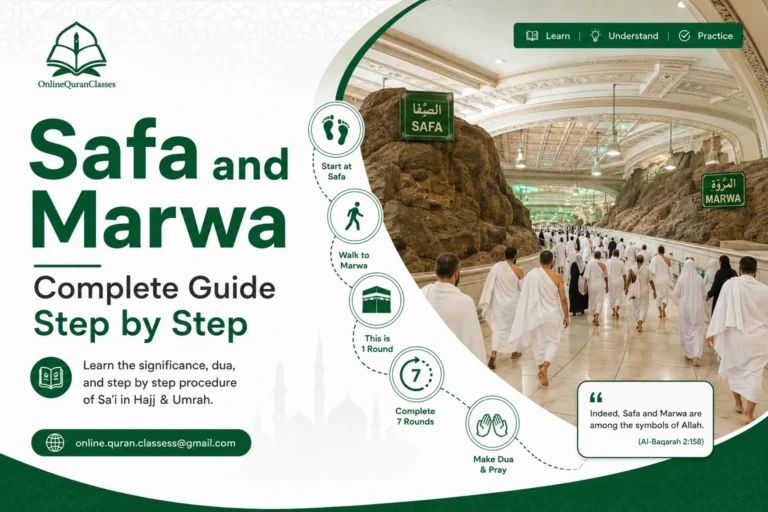
After Tawaf, pilgrims perform Sa’i, which involves walking between the hills of Safa and Marwah.
Sa’i consists of seven journeys:
- Safa to Marwah = 1
- Marwah to Safa = 2
- Safa to Marwah = 3
- Marwah to Safa = 4
- Safa to Marwah = 5
- Marwah to Safa = 6
- Safa to Marwah = 7
The ritual commemorates Hajar’s (peace be upon her) search for water for her son Ismail (peace be upon him).
Men traditionally walk faster between the designated green markers, while women continue at their normal walking pace.
Step 5: Complete Umrah and Exit Ihram for Tamattu
Pilgrims performing Hajj Tamattu complete their Umrah by performing Tawaf and Sa’i, followed by Halq or Qasr.
Men may shave their heads completely or shorten their hair. Shaving is generally considered more virtuous, while shortening is also valid.
Women shorten a small portion of their hair.
After this, pilgrims performing Tamattu leave the state of Ihram until it is time to enter Ihram again for Hajj.
Step 6: Enter Ihram Again for Hajj
On the designated day of Hajj, pilgrims performing Tamattu enter Ihram again and make the intention for Hajj.
They recite the Talbiyah and prepare to begin the main Hajj rituals.
Pilgrims performing Ifrad or Qiran follow the Ihram requirements applicable to their type of Hajj.
Step 7: Travel to Mina
The 8th of Dhul-Hijjah is commonly known as Yawm al-Tarwiyah.
Pilgrims travel to Mina and spend the day there. Pilgrims perform the prescribed prayers according to the rulings applicable to pilgrims, including shortening certain four-unit prayers.
Pilgrims should use this day to rest, pray, remember Allah, and prepare mentally and physically for the Day of Arafah.
Step 8: The Day of Arafah
The 9th of Dhul-Hijjah is the most important day of Hajj.
Pilgrims travel from Mina to Arafat and spend the designated time there in worship.
The Day of Arafah is centred around supplication, repentance, remembrance of Allah, and seeking His forgiveness.
What to Do at Arafat
Pilgrims should:
- Make abundant dua.
- Ask Allah for forgiveness.
- Recite Talbiyah and remember Allah.
- Read the Quran.
- Pray according to the prescribed schedule.
- Avoid arguments and unnecessary activities.
The standing at Arafat, known as Wuquf, is a fundamental part of Hajj. Missing the prescribed time at Arafat can invalidate Hajj, so pilgrims should follow official instructions carefully.
Step 9: Travel to Muzdalifah
After sunset on the Day of Arafah, pilgrims proceed toward Muzdalifah.
There, they perform the prescribed prayers and spend the night or part of it according to the relevant Hajj arrangements and rulings.
Pilgrims may collect pebbles for the stoning ritual. You do not need to collect many stones.
Muzdalifah is also a time for rest, prayer, remembrance, and reflection.
Step 10: Return to Mina on the 10th of Dhul-Hijjah
The 10th of Dhul-Hijjah is Yawm an-Nahr, the Day of Sacrifice.
After leaving Muzdalifah, pilgrims return to Mina and perform the major rituals associated with this day.
The sequence may vary depending on circumstances and scholarly guidance, but the major acts include:
- Rami of Jamarat al-Aqabah
- Sacrifice for pilgrims who are required to offer it
- Halq or Qasr
- Tawaf al-Ifadah
Step 11: Perform Rami of Jamarat al-Aqabah
Rami means throwing pebbles at the designated Jamarat.
On the 10th of Dhul-Hijjah, pilgrims perform Rami at Jamarat al-Aqabah, throwing seven pebbles.
Throw each pebble separately while remembering Allah.
Pilgrims should never throw large objects, push others, or put themselves in danger. Follow crowd-control instructions and the guidance of official Hajj authorities at all times.
Step 12: Sacrifice (Qurbani)
Pilgrims performing certain types of Hajj are required to offer a sacrifice.
The sacrifice commemorates the obedience of Prophet Ibrahim (peace be upon him) and the sacrifice that Allah provided in place of his son.
In organised Hajj arrangements, the sacrifice may be managed through an authorised system. Pilgrims should use official channels and avoid unauthorised arrangements.
Step 13: Halq or Qasr
After the relevant sacrifice, pilgrims perform Halq or Qasr.
Halq means shaving the head, while Qasr means shortening the hair.
For men, shaving the head is generally considered more virtuous. Women shorten part of their hair rather than shaving their heads.
This stage is an important part of completing the Hajj process and exiting the restrictions of Ihram according to the applicable rulings.
Step 14: Tawaf al-Ifadah
Pilgrims then perform Tawaf al-Ifadah, also known as Tawaf az-Ziyarah.
Pilgrims perform this essential ritual of Hajj at the Kaaba in Makkah.
If Sa’i is still required for the pilgrim’s type of Hajj, perform it according to the applicable procedure.
Because the detailed order and timing can differ by Hajj type and circumstances, pilgrims should follow their Hajj group’s guidance and a trusted scholar.
Step 15: Return to Mina for the Days of Tashreeq
After completing the required rituals in Makkah, pilgrims return to Mina for the 11th and 12th of Dhul-Hijjah, and some pilgrims remain for the 13th as well.
During these days, pilgrims perform Rami at all three Jamarat:
- Jamarat al-Sughra
- Jamarat al-Wusta
- Jamarat al-Aqabah
Pilgrims throw seven pebbles at each Jamarat, for 21 pebbles per day.
After stoning the first and second Jamarat, pilgrims may make dua. Learn the exact procedure beforehand and perform it safely.
Step 16: Leave Mina
A pilgrim may leave Mina after completing the required rituals on the 12th of Dhul-Hijjah if the conditions for an early departure are fulfilled.
Those who remain until the 13th perform Rami again and then leave Mina.
Pilgrims should follow the instructions of their Hajj authorities because transportation schedules and crowd-management arrangements can affect movement.
Step 17: Perform Tawaf al-Wada
Before leaving Makkah, a pilgrim who is required to perform the Farewell Tawaf performs Tawaf al-Wada, meaning the Farewell Tawaf.
It consists of seven circuits around the Kaaba.
Women experiencing menstruation have specific rulings regarding Tawaf al-Wada, so they should consult a qualified scholar or their Hajj group’s religious guide.
Hajj Timeline at a Glance
| Day | Main Hajj Activities |
| 8 Dhul-Hijjah | Travel to Mina and worship |
| 9 Dhul-Hijjah | Arafat, Wuquf, then Muzdalifah |
| 10 Dhul-Hijjah | Rami, sacrifice where required, Halq/Qasr, Tawaf al-Ifadah |
| 11 Dhul-Hijjah | Rami at all three Jamarat |
| 12 Dhul-Hijjah | Rami at all three Jamarat; early departure may be possible |
| 13 Dhul-Hijjah | Rami for those remaining in Mina |
| Before leaving Makkah | Tawaf al-Wada where required |
Important Duas During Hajj
You don’t need to memorise a different dua for every Tawaf circuit. Pilgrims can make personal supplications in their own language.
Some important occasions for dua include:
- During Tawaf
- At Safa and Marwah
- At Arafat
- In Muzdalifah
- After Rami
- During prayer
- Whenever seeking forgiveness and guidance
The most important thing is sincerity and remembering Allah rather than worrying about memorising a long list of duas.
What Should You Avoid During Hajj?
Hajj requires patience and good manners. Pilgrims should avoid:
- Fighting and arguing
- Pushing other pilgrims
- Hurting others
- Ignoring Ihram restrictions
- Taking unnecessary risks in crowded areas
- Wasting time on arguments or excessive shopping
- Using unauthorised transportation or services
- Leaving the group without informing responsible staff
- Neglecting prescribed prayers and other obligations
Remember that protecting other pilgrims from harm is extremely important.
Common Mistakes First-Time Pilgrims Should Avoid
Thinking Every Tawaf Circuit Has a Separate Required Dua
There is no authentic requirement to recite a specific fixed dua for every circuit. Worshippers can make dua and remember Allah throughout Tawaf.
Pushing to Touch the Black Stone
Touching or kissing the Black Stone should never become an excuse for harming another Muslim. If reaching it safely is not possible, pilgrims can gesture toward it when beginning the circuit.
Collecting Too Many Pebbles
A small number of suitable pebbles is sufficient. Carrying too many stones creates unnecessary inconvenience.
Neglecting Rest
Hajj involves significant walking and crowded environments. Proper hydration, rest, and following medical advice can help pilgrims preserve their strength for important rituals.
Ignoring Official Instructions
Hajj is a massive gathering. Official Hajj authorities and your group control transportation, movement between locations, and access arrangements for safety.
Hajj Packing Checklist
Before travelling, consider preparing:
- Ihram clothing
- Comfortable walking footwear
- Unscented toiletries
- Small personal bag
- Water bottle
- Necessary medications
- Phone and charger
- Portable power bank where permitted
- Identification and travel documents
- Hajj guide or dua book
- Basic personal hygiene supplies
Avoid overpacking because pilgrims will frequently move between locations.
How to Stay Healthy During Hajj
Hajj can be physically demanding. Pilgrims should drink sufficient fluids, rest when necessary, protect themselves from excessive heat, and follow local health requirements.
Wear comfortable footwear and avoid unnecessary walking when transportation is available.
If you feel seriously unwell, seek medical assistance rather than trying to continue without help.
Hajj Packages and Planning Your Journey
When arranging your pilgrimage, compare the services included in different hajj packages, such as accommodation, transportation, meals, guidance, and proximity to important locations.
Do not choose a package based solely on price. Check whether the provider is officially authorised, understand the included services, and carefully review the terms before making arrangements.
Hajj Checklist for First-Time Pilgrims
Use this simplified checklist:
- Learn the basic Hajj rituals
- Confirm your Hajj type
- Prepare travel documents
- Learn Ihram restrictions
- Enter Ihram at the correct Miqat
- Recite Talbiyah
- Perform required Tawaf
- Perform Sa’i when required
- Complete Umrah if performing Tamattu
- Enter Ihram for Hajj
- Travel to Mina
- Perform Wuquf at Arafat
- Travel to Muzdalifah
- Perform Rami
- Complete sacrifice where required
- Perform Halq or Qasr
- Perform Tawaf al-Ifadah
- Complete Rami during the Days of Tashreeq
- Perform Tawaf al-Wada when required
- Leave Makkah safely
Final Thoughts
Hajj is a profound act of worship that requires preparation, patience, discipline, and sincerity. For first-time pilgrims, understanding the order of the major rituals can reduce confusion and help them focus on worship.
The key stages include entering Ihram, performing the required Tawaf and Sa’i, travelling to Mina, standing at Arafat, spending time in Muzdalifah, performing Rami, completing the sacrifice where required, Halq or Qasr, Tawaf al-Ifadah, the Days of Tashreeq, and, when required, Tawaf al-Wada.
Because details can vary by the type of Hajj, personal circumstances, and the rulings followed by the pilgrim, it is wise to study the rituals before travelling and consult a qualified Islamic scholar with specific questions. Always prioritise your safety and that of fellow pilgrims while completing this blessed journey.
Frequently Asked Questions About Hajj
How many days does Hajj take?
The main Hajj rituals occur from the 8th through the 12th or 13th of Dhul-Hijjah. The overall travel period can be considerably longer depending on the pilgrim’s itinerary, accommodation, and arrangements.
What is the most important day of Hajj?
The 9th of Dhul-Hijjah, the Day of Arafah, is the central day of Hajj. Wuquf at Arafat during its prescribed time is essential to Hajj.
How many times is Tawaf performed during Hajj?
Depending on the pilgrim’s Hajj type and circumstances, the pilgrimage involves Tawaf associated with arrival, Hajj, and farewell. The exact required Tawafs can differ, so pilgrims should learn the requirements for their particular type of Hajj.
Do women have to wear white during Hajj?
No. Women are not required to wear a specific colour for Ihram. Their clothing should be modest and comply with Islamic requirements.
Can I make dua in my own language during Hajj?
Yes. Personal supplication can be made in a language the pilgrim understands. You are not required to use Arabic for every personal dua.
What happens if I make a mistake during Hajj?
Not every mistake has the same ruling. Some mistakes may require a compensatory sacrifice, while others may not affect the validity of Hajj. The correct ruling depends on what happened, the type of Hajj, and other circumstances. Ask a qualified scholar promptly rather than relying on assumptions.